

Throughout the year 2025, the Company operated amid challenges from volatility in the rubber glove industry by several external factors. These included the U.S. Reciprocal Tariff measures, the expansion of production capacity by various industry players that continued to intensify price competition, fluctuations in raw material prices, the appreciation of the Thai Baht, and flooding in areas surrounding some of the Company’s manufacturing facilities in Hat Yai District, Songkhla Province. However, the Company maintained its competitiveness effectively through a flexible production structure covering both natural rubber (NR) and nitrile rubber (NBR) gloves, as well as product diversification supported by research and development to meet customer needs. In addition, the Company expanded its market presence across different regions worldwide to achieve strategic balance, reduce the risk of reliance on a single market, and enhance long-term operational stability. In 2025, the Company recorded total revenue of THB 23,890 million, sales volume of 37,102 million pieces, and EBITDA (excluding special items) of THB 3,427 million.
Although the flooding in the southern region toward the end of the year was another significant event that affected the community, employees, and the Company’s operations, resulting in temporary shutdowns and damage at some of the Company’s manufacturing facilities, the Company promptly carried out systematic recovery efforts. This included repairing machinery, restoring operational areas, managing business continuity, ensuring employee welfare, and providing appropriate assistance to surrounding communities. Most facilities were able to resume operations within a short period of time. With the dedication and capabilities of our personnel, together with the Company’s operational strategies and the confidence and support from all stakeholders, the Company was able to recover from this incident in a stable manner and continue moving forward to drive strong and sustainable long-term growth.
Advancing toward a Sustainable Supply Chain Leader through the “TRACEABILITY” Mission
The Company strengthened its sustainability efforts through the “TRACEABILITY” mission in 2025, aiming to enhance a transparent and verifiable supply chain. This is achieved through the use of natural rubber raw materials that can be fully traced back to their origins and assessed under the EU Deforestation Regulation (EUDR) risk-evaluation framework at the plantation level, ensuring that the Company’s products use raw materials free from deforestation and comply with EUDR requirements, as well as any additional regulations that may arise in the future. The Company also promotes and supports collaboration with supply chain stakeholders to jointly enhance sustainability standards and meet global market needs. The Company has supplied EUDR-compliant gloves to more than 19 countries, with demand continuing to rise in the European market. In addition, the Sri Trang Group has elevated its FSCTM standards by integrating the EUDR requirements, enabling FSCTM certification under the FSC-STD-01-004 FSC Regulatory Module (FSC100%/Reg) since August 2025. This strengthens product credibility, enhances differentiation, and responds to increasing expectations from customers and consumers worldwide who place greater importance on sustainability. Moreover, the expertise gained in supply chain traceability enables the Company to effectively adapt to additional standards and regulatory requirements that may emerge in the future.
Integrating Sustainable Business Strategies under the “Clean World Clean Gloves” Concept
In addition, as the Company has set a Net Zero target by 2050 to reduce greenhouse gas emissions in line with the Science Based Targets initiative (SBTi), the Company has implemented clear strategies and action plans, including energy-efficiency improvements, the transition to low-carbon technologies, and greenhouse gas sequestration through various activities. In 2025, the Company reduced greenhouse gas emissions per product unit (Scope 1 and 2) by 12.72%, compared to 2024 (base year), and reduced greenhouse gas emissions of organization (Scope 1 and 2) by 17.24%, compared to 2024 (base year), achieving the planned targets. Furthermore, all of the Company’s manufacturing facilities completed greenhouse gas emissions verification in accordance with the requirements for carbon footprint calculation and reporting under the GHG Protocol. The Company also registered 24 product groups under the Carbon Footprint of Product (CFP) program with the Thailand Greenhouse Gas Management Organization (Public Organization).
Knowledge Management for Sustainable Growth
In 2024, the Company developed employees by promoting and increasing skills in artificial intelligence (AI) and the use of various technologies and programs, as well as supporting knowledge in ESG and EUDR to develop the organization towards sustainability and digital transformation and greater automation, in line with the Company's mission and development strategy to achieve the set goals. The Company has promoted and organized 2,523 training courses, at a cost of THB 10.36 million. As a result of the development and investment in applying knowledge and various technologies within the organization, production has been carried out efficiently and limited resources have been used most effectively, reducing labor use and production costs. Currently, the Company has transitioned its database from documents to digitization, accounting for 92 percent, and uses a data platform to centralize information using data from such sources to make decisions on business operations efficiently. In addition, the use of Vision Camera to detect defective gloves has found the production efficiency and glove quality inspection to be 99 percent, and the use of Sensors to collect data and inspect energy usage in real time is up to 99 percent, allowing the production department to have retrospective data to make decisions quickly when problems occur.
The Company continued to promote the use of solar energy through the installation of Solar Rooftop and Floating Solar systems across all six manufacturing facilities, with a total installed capacity of 14.72 megawatts, increasing from 2.97 megawatts in 2024. The systems generate an average of 20,632 megawatt-hours per year, which is used in the production processes and office operations. This resulted in a reduction of 9,800 tCO2eq per year in Scope 2 emissions from purchased electricity and generated electricity cost savings of approximately THB 81 million. Regarding key performance results under the Company’s energy management targets in 2025, the Company reduced electricity consumption per unit of product by 18.50%, compared with the 2019 base year, which is an improvement of 4.06% compared with 2024. For waste management, initiatives under various projects enabled the Company to reduce non-hazardous production waste disposed of via landfill per unit of product by 6.05%, compared with the 2024 base year. As a result of its environmental management performance, the Sadao P.S. facility received the Green Industry Level 4 (Green Culture) Award for 2025 from the Ministry of Industry. In addition, all of the Company’s manufacturing facilities continued to maintain ISO 14001 environmental management system certification, achieving 100% coverage in line with the Company’s sustainability targets.
In terms of sustainability-related investments, as of 31 December 2025, the Company had fully utilized the proceeds from the issuance and offering of its Green Bond, with a total amount of THB 1,500 million, enabling the Company to drive its operations in line with the established objectives and strategies. In addition, in 2025, the Company obtained a Sustainability-Linked Loan (SLL) in a total amount of THB 2,000 million, under which the loan interest rate is adjusted upward or downward each year based on performance against sustainability targets. These targets are linked to key sustainability indicators, including reducing greenhouse gas emissions (Scope 1 and 2) per unit of product by 20% by 2030 compared with the 2024 base year, and reducing non-hazardous production waste sent to landfill per unit of product by 50% by 2030 compared with the 2024 base year. The Sustainability-Linked Loan represents an important milestone that reflects the Company’s capability to drive business objectives through sustainability strategies integrated with financial strategies, while elevating corporate standards to an international level and maintaining the Company’s leadership in the global rubber glove industry in line with the “Clean World Clean Gloves” concept, reinforcing sustainable growth alongside environmental responsibility.
Building a Sustainable Value Chain with Responsibility from Upstream to Downstream
The Company is committed to social responsibility throughout its business value chain by safeguarding labor rights, prohibiting child labor and forced labor, respecting human rights, and implementing other relevant practices. As a result, all of the Company’s manufacturing facilities have obtained key international certifications. The Company’s operations were also assessed for human rights risks and impacts at 100% coverage, in accordance with the Company’s sustainability targets. In addition, the Company places strong emphasis on occupational health and safety, operating in accordance with the ISO 45001:2018 standard. The Company achieved zero work-related fatalities and zero occupational illnesses, meeting its established targets. The Company also supports the enhancement of employee skills and capabilities to ensure alignment with its mission and development strategies, particularly in the areas of artificial intelligence (AI) and digital tools. The Company is promoting AI adoption across its operations and strengthening workforce readiness through initiatives such as the launch of the “AI Clinic,” which provides employees with a platform to present AI-related ideas and receive guidance from AI specialists for practical application. In 2025, the Company supported and organized 2,292 training courses, with a total expenditure of THB 9 million.
The Company also implements CSR policies and activities that promote sustainable coexistence with local communities by building knowledge, creating jobs, and distributing income to the community in response to stakeholder expectations. Examples include the project developed from the stingless bee farming initiative, which expanded into the production of stingless bee honey under the brand “1,000 Kesorns” The Company supported the project by providing product branding design and sharing knowledge on online sales channels to enhance market opportunities and strengthen community sustainability. In 2025, the project helped reduce costs and generate a total income of THB 96,480 for community members, with a Social Return on Investment (SROI) of 4.60 times. Following the flooding in the southern region in November 2025, the Company carried out relief operations to support affected communities. Assistance included the distribution of drinking water and more than 1,300 relief packages, as well as the deployment of employee volunteers and fire trucks to clean communities, schools, and hospitals in more than 25 locations. The Company also donated funds to public health agencies and provided over 900,000 pieces of medical and general-purpose rubber gloves to government agencies, field hospitals, and evacuation centers across Songkhla, Yala, Pattani, and Narathiwat. The Company also prioritized the welfare and safety of both permanent and daily employees. Relief measures included the distribution of food and essential supplies, financial assistance, and employee home cleaning support. In addition, the Company established the Sri Trang Community Kitchen and temporary shelters to support employees affected by the flooding, providing food, clean and safe accommodation, and 24-hour nursing care.
The Company places importance on its business partners in both commercial and corporate governance aspects. The Company expanded its transparent business network to suppliers under the CAC Change Agent project, with more than 10 suppliers joining in the first year to declare their commitment to anti-corruption. As a result, the Company was certified as a CAC Change Agent member and received the CAC Change Agent Award 2025. The Company also communicated its Code of Conduct to all business partners, all of whom, representing 100 percent, acknowledged and signed the Code of Conduct. In addition, the Company conducted business ethics and labor standards audits in accordance with the SMETA Sedex Members Ethical Trade Audit standard and completed 100 percent ESG risk assessments covering environmental, social, and governance issues across supplier operational sites, in line with its sustainability targets. Moreover, the Company conducts business ethically and maintains strong collaboration with its partners, resulting in the Company receiving the SX TSCN Sustainability Award 2025 for the second consecutive year from the Thailand Supply Chain Network TSCN, as well as the Platinum Business Partners Award for the second consecutive year and the Business Partner of the Year 2025 Award from Thai Beverage Public Company Limited. These recognitions reflect the trust and confidence of business partners in fostering collaboration to deliver value to consumers and to advance the industry toward sustainable development.
In terms of customer relations, the customer satisfaction survey result was 85.69 percent, which exceeded the target of 80.00 percent. The Company has made its best efforts to ensure that customers receive prompt responses and has analyzed customer feedback to identify root causes for improvement and prevention. The Company also places great importance on safeguarding customer confidentiality and does not use customer information for its own benefit or for the improper benefit of any related parties. Throughout the reporting period, there were no complaints related to customer personal data, and the Company successfully maintained the security of personal data with zero data breach incidents. The Company also complied 100 percent with the requirements of the Personal Data Protection Act B.E. 2562 (PDPA), in line with its sustainability targets.
Strengthening Corporate Governance through Technology and International Standards
The Company assessed its internal control system with reference to the international standards of the Committee of Sponsoring Organization of the Treadway Commission COSO 2013. The Company also assessed the quality of its internal audit function in accordance with the Quality Assurance and Improvement Program QAIP. The Audit Committee concluded that the Internal Audit Department operates in alignment with international internal auditing standards. In addition, the Company adopted Power BI as a data analytics tool to analyze user access rights in the SAP system, helping enhance the quality and efficiency of internal audit activities in accordance with international internal auditing standards. For risk management, the Company achieved certification under the business continuity management standard ISO 22301 2019, demonstrating effective performance in this area. In 2025, the Company reviewed and assessed Enterprise Risk Management ERM and updated the risk ranking to align with the Company’s business conditions and environmental factors during the year. The Company identified risk factors that include emerging risks and environmental, social, and governance ESG risks, and also analyzed and assessed risks, opportunities, business impacts, and financial impacts related to climate change.
For technology and artificial intelligence AI development, the Company has adopted AI and Internet of Things IoT technologies to analyze and improve production processes, and has placed importance on the use of AI Agents, particularly in office operations. In addition, in 2025, the Sri Trang Group established a data governance policy and operating procedures, which represent an important part of preparing the corporate data infrastructure to ensure effective management of data as a key organizational asset. This not only supports faster and more accurate decision making, but also enhances business credibility and strengthens the Company’s long term competitiveness, moving toward becoming a data driven organization. The Group Company’s AI development has progressed as planned, with preparations in place for data, infrastructure, and processes to support the expansion of AI adoption in the future. This aligns with the development direction for 2026, in which the Company is committed to the mission “Empowering AI: The Power of Artificial Intelligence” to promote the application of AI across all areas of the organization. The Company also places emphasis on developing manufacturing AI technologies to enhance efficiency, accuracy, and innovation in production processes, with the goal of expanding these capabilities across all operational dimensions in the future.
From the Company’s effective performance in corporate governance and sustainability, the Company received several awards and rankings at both national and international levels. These include the Best Sustainability Awards in the Consumer Products category from the Stock Exchange of Thailand at the SET Awards 2025, and the ranking as a Sustainability Yearbook Member in the Healthcare Equipment and Supplies sector in the S&P Global Sustainability Yearbook 2026. The Company also received an ESG Risk Rating assessment from Morningstar Sustainalytics, which rated the Company’s ESG risk level as low.
On behalf of the Board of Directors, I would like to express our appreciation to all shareholders, customers, business partners, and stakeholders for your continued confidence in and support for the Company. I would also like to thank all employees for their dedication and collective effort in fulfilling the Company’s mission and objectives, which drive the organization toward industry leadership. The Company remains committed to creating both value and worth through continuous capability enhancement and development. We will continue to bring opportunities and strong performance to the organization, stakeholders, and society, ensuring that we grow sustainably together.
Sri Trang Gloves (Thailand) Public Company Limited
Sri Trang Gloves (Thailand) Public Company Limited
Stakeholders Engagement (GRI 2-12)
The Company has identified stakeholders involved in operations throughout the value chain, analyzed and ranked the stakeholders by considering the criteria of the impact of the Company’s operations on the stakeholders and the criteria of the influence of the stakeholders on the business operations (GRI 2-29). To appropriately and effectively respond to the stakeholders’ expectations of the Company’s business operations, the Company has designated responsible units, defined obligations, and operations in accordance with the guidelines set by the Company.
The needs expectations of the stakeholders and the suitable response thereof are annually reviewed and improved as appropriate. In the year 2025, the Company classified stakeholders into 7 groups, in order of importance as follows:
| Communication Channels/Participation: |
|
| Needs/Expectations: |
|
| Response to Expectation: |
|
| Indicators/Results for 2025: |
|
| Communication Channels/Participation: |
|
| Needs/Expectations: |
|
| Response to Expectation: |
|
| Indicators/Results for 2025: |
|
| Communication Channels/Participation: |
|
| Needs/Expectations: |
|
| Response to Expectation: |
|
| Indicators/Results for 2025: |
|
| Communication Channels/Participation: |
|
| Needs/Expectations: |
|
| Response to Expectation: |
|
| Indicators/Results for 2025: |
|
| Communication Channels/Participation: |
|
| Needs/Expectations: |
|
| Response to Expectation: |
|
| Indicators/Results for 2025: |
|
| Communication Channels/Participation: |
|
| Needs/Expectations: |
|
| Response to Expectation: |
|
| Indicators/Results for 2025: |
|
| Communication Channels/Participation: |
|
| Needs/Expectations: |
|
| Response to Expectation: |
|
| Indicators/Results for 2025: |
|
1. Business Partners/Suppliers cover suppliers, outsourcing, and contractors.
2. * On February 19, 2026, the Board of Directors resolved to approve the dividend payment for the year 2025 at the rate of 0.50 baht per share. However, the right to receive such dividend remains uncertain until it is approved by the Annual General Meeting of Shareholders for the year 2026, which will be held on April 9, 2026.
3. ** The number of visitors to the Company’s website related to investor relations is counted using Google Analytics 4 (GA4).
Materiality Assessment
The Company recognizes that the identification and management of material sustainability topics constitute a critical foundation for responsible business conduct and the creation of long-term value. To ensure that governance and economic, social and environmental performance align with sustainable development objectives, respond to stakeholder expectations, and remain measurable, the Company conducts a systematic process to identify, assess, and prioritize material topics (Materiality Assessment) on a regular basis, with a comprehensive review undertaken biennially. This process involves active engagement with relevant internal and external stakeholders to enable appropriate and effective management of these topics. The assessment encompasses both impact materiality, which analyses the positive and negative impacts on people, the environment, and society arising from the Company's operations throughout the value chain, and financial materiality, which evaluates sustainability-related risks and opportunities that may affect the Company's financial performance and position.
Materiality Assessment Process (GRI 3-1)
In the year 2025, the Company conducted the identification and assessment of material sustainability topics based on the Double Materiality assessment under the Corporate Sustainability Reporting Directive (CSRD) framework; a European Union directive mandating eligible companies to report sustainability performance in accordance with the European Sustainability Reporting Standards (ESRS). The assessment also references the GRI Standards and the United Nations Sustainable Development Goals (UN SDGs) to ensure alignment with international sustainability disclosure frameworks. This comprehensive approach encompasses impacts on the economy, society, and the environment, as well as their materiality to the business.
The materiality assessment process consists of four principal stages, as follows:

Understand the organization’s context
Define the scope of business activities and related value chain
- Activities: Identify core business operations and their linkages across the value chain.
- Context: Review of industry trends, regulatory developments, ESG standards, and sustainability rating agencies such as S&P Global, EcoVadis, MSCI and FTSE Russell.
- Stakeholder Engagement: Identify affected stakeholders, analysis of stakeholder interests, and annual collection of expectations and feedback through online surveys.

Identify actual and potential impacts (Impact Materiality)
Assess the Company’s impact on people, the environment, and human rights (Inside-out)
Negative Impacts ( - )
- Evaluate severity based on Scale, Scope, Irremediable Character and Likelihood
- Identify actual impacts and potential future impacts
Positive Impacts ( + )
- Assess beneficial impacts using Scale, Scope and Likelihood
- Identify actual impacts and potential future impacts

Assess the significance of impacts (Financial Materiality)
Assess sustainability-related financial impacts on business performance (Outside-in)
Risk
- Assess risks that may affect financial outcomes and stakeholder confidence, including short-, medium-, and long-term impacts.
- Use financial data and relevant statistics to determine materiality thresholds
Opportunity
- Analyze opportunities that may enhance financial performance, growth, competitive advantage, or corporate reputation, including short-, medium-, and long-term impacts
- Use financial data and relevant statistics to determine materiality thresholds

Prioritize the most significant impacts for reporting
Prioritize the material topics under the Double Materiality approach for management and sustainability report disclosure
Risk
- Consolidate material topics from both Impact and Financial Materiality assessments
- Review and validate by the Sustainability Development Working Group, endorse by the Corporate Governance and Sustainability Development Committee and approve by the Board of Directors for disclosure.
- Conduct independent third-party assurance of the assessment process and outcomes
Double Materiality Prioritization of Material Sustainability Topics
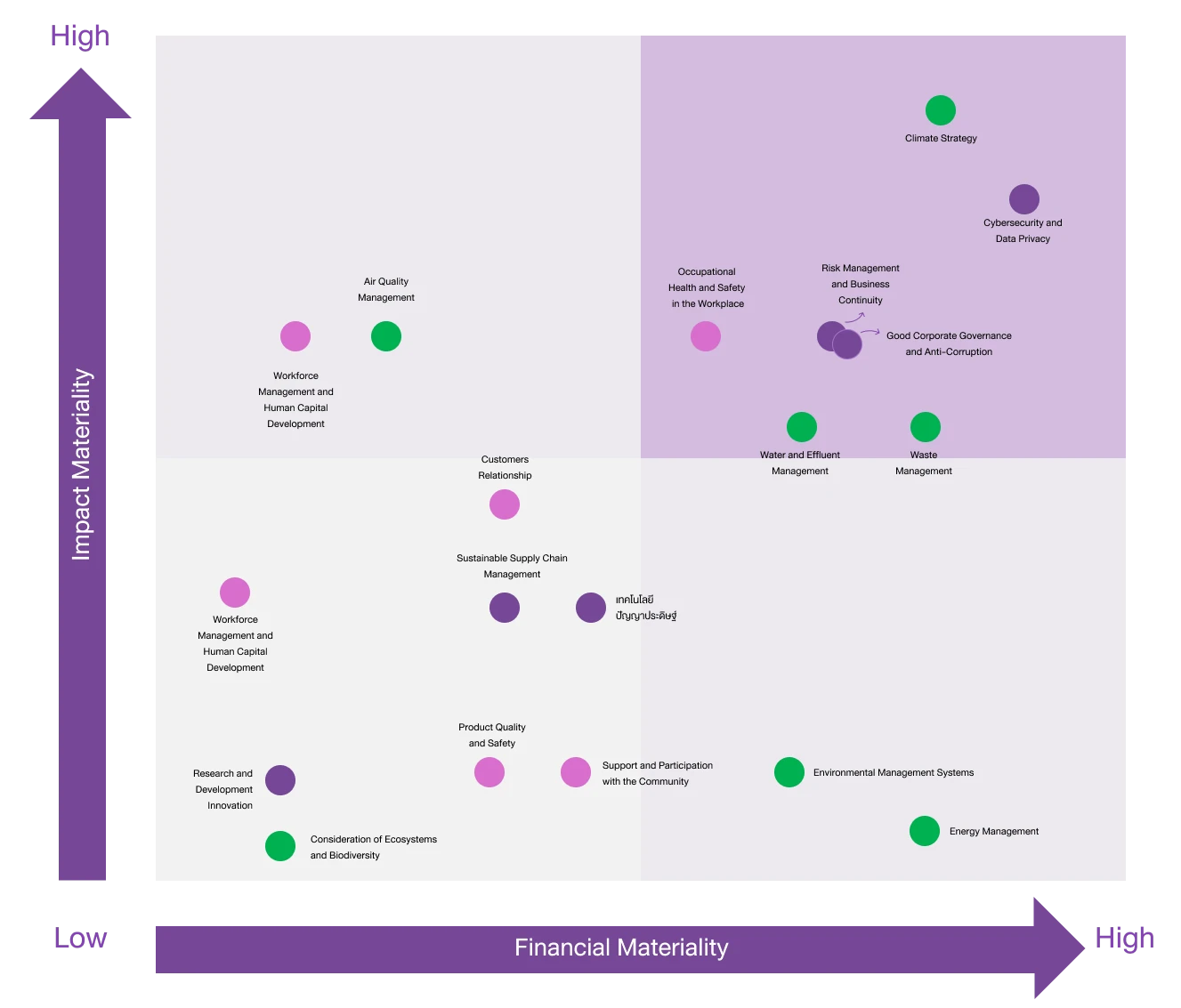
The 19 material sustainability topics and their significance by materiality dimension (GRI 3-2)
| No. | Material Topics | Impact Materiality | Financial Materiality | Double Materiality |
|---|---|---|---|---|
| Governance Dimension | ||||
|
1 |
Good Corporate Governance and Anti-Corruption |
|
|
|
|
2 |
Cybersecurity and Data Privacy |
|
|
|
|
3 |
Risk Management and Business Continuity |
|
|
|
|
4 |
Sustainable Supply Chain Management |
- |
- |
- |
|
5 |
Research Development and Innovation |
- |
- |
- |
|
6 |
Artificial Intelligence |
- |
- |
- |
| Social Dimension | ||||
|
7 |
Support and Participation with the Community |
- |
- |
- |
|
8 |
Occupational Health and Safety in the Workplace |
|
|
|
|
9 |
Product Quality and Safety |
- |
- |
- |
|
10 |
Customers Relationship |
- |
- |
- |
|
11 |
Human Rights and Non-Discrimination |
|
- |
- |
|
12 |
Workforce Management and Human Capital Development |
- |
- |
- |
| Environmental Dimension | ||||
|
13 |
Climate Strategy |
|
|
|
|
14 |
Air Quality Management |
|
- |
- |
|
15 |
Waste Management |
|
|
|
|
16 |
Energy Management |
- |
|
- |
|
17 |
Water and Effluent Management |
|
|
|
|
18 |
Environmental Management Systems |
- |
|
- |
|
19 |
Consideration of Ecosystems and Biodiversity |
- |
- |
- |
Governance Dimension
| Material Sustainability Topic | Reported Content |
Page | ||||||
|---|---|---|---|---|---|---|---|---|
| Stakeholders | Social and Environmental Impact |
Risk and Opportunity | Assessment Results by Dimension | |||||
| Time Horizon | Impact Materiality | Financial Materiality | Double Materiality | |||||
| Material Topic: Cybersecurity and Data Privacy | ||||||||
|
Negative impact
Positive impact
|
Risk
Opportunity
|
Short term (1-2 years) | Very High | Very High |
|
Cybersecurity and Data Privacy | 89-99 |
| Material Topic: Risk Management and Business Continuity | ||||||||
|
Negative impact
Positive impact
|
Risk
Opportunity
|
Short term (1-2 years) | High | High |
|
Risk Management and Business Continuity | 78-88 |
| Material Topic: Good Corporate Governance and Anti-Corruption | ||||||||
|
Negative impact
Positive impact
|
Risk
Opportunity
|
Short term (1-2 years) | High | High |
|
|
|
| Material Topic: Artificial Intelligence | ||||||||
|
Negative impact
Positive impact
|
Risk
Opportunity
|
Short term (1-2 years) and Medium term (3-5 years) | Medium | Medium | - | Artificial Intelligence | 100-103 |
| Material Topic: Sustainable Supply Chain Management | ||||||||
|
Negative impact
Positive impact
|
Risk
Opportunity
|
Medium term (3-5 years) and Long term (>5 years) | Medium | Medium | - |
|
|
| Material Topic: Research Development and Innovation | ||||||||
|
Negative impact
Positive impact
|
Risk
Opportunity
|
Medium term (3-5 years) and Long term (>5 years) | Low | Medium | - | Research Development and Innovation | 112 |
 Employees (the Company)
 Business Partners/Suppliers
 Customers/Consumers
 Shareholders/Investors/Analysts
 Related Government Agencies/ Enterprises/Private Sector Agencies
 Creditors/Banks
Social Dimension
| Material Sustainability Topic | Reported Content |
Page | ||||||
|---|---|---|---|---|---|---|---|---|
| Stakeholders | Social andEnvironmental Impact | Risk and Opportunity | Assessment Results by Dimension | |||||
| Time Horizon | Impact Materiality | Financial Materiality | Double Materiality | |||||
| Material Topic: Occupational Health and Safety in the Workplace | ||||||||
|
Negative impact
Positive impact
|
Risk
Opportunity
|
Short term (1-2 years) | High | High |
|
|
|
| Material Topic: Human Rights and Non-Discrimination | ||||||||
|
Negative impact
Positive impact
|
Risk
Opportunity
|
Short term (1-2 years) to Long term (>5 years) | High | Medium | - |
|
115 |
| Material Topic: Customers Relationship | ||||||||
|
Negative impact
Positive impact
|
Risk
Opportunity
|
Short term (1-2 years) | Medium | Medium | - | Customers Relationship | 151 |
| Material Topic: Workforce Management and Human Capital Development | ||||||||
|
Negative impact
Positive impact
|
Risk
Opportunity
|
Medium term (3-5 years) and Long term (>5 years) | Medium | Medium | - |
|
|
| Material Topic: Support and Participation with the Community | ||||||||
|
Negative impact
Positive impact
|
Risk
Opportunity
|
Short term (1-2 years) and Medium term (3-5 years) | Low | Medium | - | Support and Participation with the Community | 153 |
| Material Topic: Product Quality and Safety | ||||||||
|
Negative impact
Positive impact
|
Risk
Opportunity
|
Short term (1-2 years) and Medium term (3-5 years) | Low | Medium | - | Customers and Consumers Responsibility | 148 |
 Communities
Environmental Dimension
| Material Sustainability Topic | Reported Content |
Page | ||||||
|---|---|---|---|---|---|---|---|---|
| Stakeholders | Social andEnvironmental Impact | Risk and Opportunity | Assessment Results by Dimension | |||||
| Time Horizon | Impact Materiality | Financial Materiality | Double Materiality | |||||
| Material Topic: Climate Strategy | ||||||||
|
Negative impact
Positive impact
|
Risk
Opportunity
|
Medium term (3-5 years) and Long term (>5 years) | Very High | High |
|
|
|
| Material Topic: Waste Management | ||||||||
|
Negative impact
Positive impact
|
Risk
Opportunity
|
Short term (1-2 years) and Medium term (3-5 years) | High | High |
|
|
|
| Material Topic: Water and Effluent Management | ||||||||
|
Negative impact
Positive impact
|
Risk
Opportunity
|
Short term (1-2 years) and Medium term (3-5 years) | High | High |
|
|
|
| Material Topic: Air Quality Management | ||||||||
|
Negative impact
Positive impact
|
Risk
Opportunity
|
Short term (1-2 years) | High | Medium | - |
|
|
| Material Topic: Energy Management | ||||||||
|
Negative impact
Positive impact
|
Risk
Opportunity
|
Short term (1-2 years) to Long term (>5 years) | Low | High | - |
|
|
| Material Topic: Environmental Management Systems | ||||||||
|
Negative impact
Positive impact
|
Risk
Opportunity
|
Short term (1–2 years) and Medium term (3–5 years) | Low | High | - |
|
|
| Material Topic: Consideration of Ecosystems and Biodiversity | ||||||||
|
Negative impact
Positive impact
|
Risk
Opportunity
|
Medium term (3-5 years) and Long term (>5 years) | Medium | Low | - | Consideration of Ecosystems and Biodiversity | 203 |
Membership of Organizations for Governance, Social and Environmental Development (GRI 2-28)
The Company has become members of various public and private organizations that contribute to the governance, social and environmental development of the natural rubber industry, and has joined working groups and participated in various activities and projects that support the implementation of the guidelines for sustainable development
Governance
- The Federation of Thai Industries, FTI
- The Federation of Thai Industries Provincial Chapter (where the company is located)
- Malaysian Rubber Glove Manufacturers Association (MARGMA)
- Thai AEO Importer & Exporter Association
- Department of International Trade Promotion, Ministry of Commerce
- Thai Listed Companies Association
- Sustainability Disclosure Community, Thaipat Institute
Social
- Unicef Thailand (CRBP)
- CSR club, Thai Listed Company Association
Environment
- Provincial Environmental Governance Network
- Thailand Carbon Neutral Network (TCNN)